
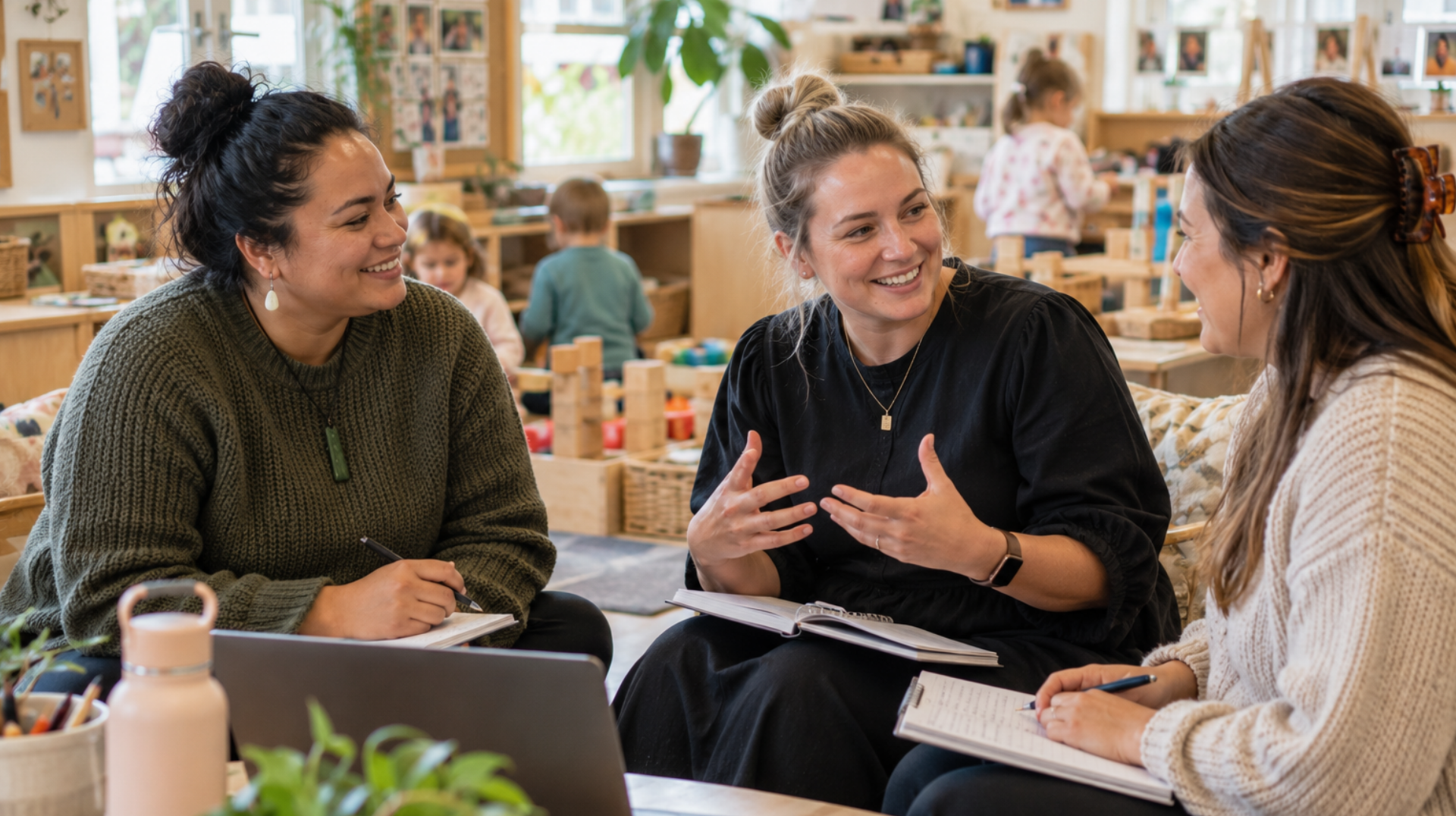
When we think about professional development, we often picture an expert standing at the front of a room, an online course, or a conference presentation. These can all be valuable ways to learn, but professional growth does not always have to come from someone outside the team.
Some of the most meaningful learning can happen through conversations with the people working alongside us.
Every ECE setting is full of experience, knowledge and different perspectives. One kaiako may have developed a particularly effective way of supporting transitions. Another may have a wonderful approach to working with whānau. Someone else may have years of experience navigating challenging situations or supporting new team members.
What happens when we create opportunities for that knowledge to be shared?
Learning From the People Around Us
Peer learning is simply the process of learning with and from colleagues. It can happen formally through mentoring and peer observation, or informally through conversations over a cup of tea, team meetings and sharing ideas throughout the day.
It might be as simple as asking a colleague:
“I noticed how you supported that child during the transition. Can you tell me more about what you were thinking?”
That kind of conversation can turn an everyday moment into professional learning.
Importantly, peer learning is not about deciding who is doing things "right". It is about becoming curious about practice.
What works well?
Why might it work?
Could it work in another context?
What might we try differently?
These questions encourage reflection rather than judgement.
The Value of Peer Observation
Watching another kaiako work can provide insights that are difficult to gain from reading about a teaching strategy.
Perhaps you observe how they ask questions without taking over children's play. You might notice how they give tamariki more time to respond, or how they use their body language and tone of voice to create a calm environment.
The purpose isn't to copy another person's practice exactly. Instead, observation gives us another perspective to reflect on our own practice.
Sometimes we learn just as much from noticing what feels different as we do from seeing something we want to adopt.
Mentoring Works Both Ways
Mentoring is another powerful form of peer learning, particularly when experienced kaiako support newer members of the profession.
But mentoring doesn't have to be a one-way relationship.
Newer educators bring their own experiences, questions, ideas and perspectives. Experienced kaiako bring knowledge built through years of practice. When both people approach the relationship with curiosity and respect, everyone has an opportunity to learn.
A strong mentoring relationship might involve asking questions rather than simply providing answers:
“What do you think the child was communicating?”
“What could you try next time?”
“What did you notice about how the children responded?”
These conversations help educators develop their own professional judgement and confidence.
Creating a Culture of Shared Learning
Peer learning is most powerful when it becomes part of the culture of an ECE setting rather than another task added to an already busy schedule. Leaders can create opportunities by making time for:
- Peer observation and feedback
- Reflective team discussions
- Mentoring and coaching
- Sharing successful strategies
- Discussing challenges without blame
- Celebrating professional learning
- Asking "what can we learn from this?" after difficult situations
It is also important to create psychological safety. People are much more likely to share ideas, ask questions and acknowledge areas they are still developing when they know they won't be judged for doing so.
A learning culture is not one where everyone already has the answers. It is one where people feel comfortable asking questions.
Learning Beyond Your Own Centre
Peer learning doesn't have to stop with the people you work with every day.
Connecting with educators from other ECE settings can provide an entirely different perspective. Other leaders and kaiako may be facing similar challenges, but approaching them in different ways.
This is one of the ideas behind Learning Hub's Leaders Lab Network Groups. Rather than simply learning from a facilitator, participants have the opportunity to connect with other ECE leaders, share experiences and learn from the perspectives of people working in similar leadership roles.
These professional networks can be particularly valuable because leadership can sometimes feel isolating. Having a group of people who understand the realities of ECE leadership creates space to ask questions, exchange ideas and reflect on challenges together.
For those working towards their Professional Growth Cycle, PGC Peer Pods provide another opportunity for collaborative professional learning. Peer support can help educators reflect on their goals, share experiences and maintain momentum throughout their professional growth journey.
Both approaches recognise something important: professional learning doesn't always have to happen to us. It can happen with us.
From Conversation to Change
Of course, simply having conversations isn't enough. The real value of peer learning comes when reflection leads to action.
A useful conversation might finish with:
“What could we try?”
Then, after some time:
“What happened when we tried it?”
This creates a cycle of learning, experimentation and reflection.
Try something new.
Observe what happens.
Talk about it.
Reflect.
Adapt.
Try again.
That process can be incredibly powerful because professional development becomes connected to the real tamariki, relationships and challenges educators encounter every day.
Everyone Has Something to Teach
One of the most valuable things about peer learning is that expertise doesn't belong to just one person.
A new kaiako might ask a question that challenges an established way of thinking. An experienced educator might share an insight that changes how a colleague approaches a situation. A centre leader might learn something valuable from another leader facing a completely different set of circumstances.
When we create cultures where people are encouraged to share, question, listen and reflect, professional development becomes part of everyday practice.
At 4E's Learning Hub, we believe professional learning is about more than collecting certificates or completing courses. It is about building capability, confidence and connections that make a difference in practice.
Sometimes the next great professional development opportunity isn't another course. It might be the person sitting beside you at your centre, or chatting with you virtually from across the motu.